.png?width=2196&height=2196&name=OS%20(1).png)



.svg)

-3.png?width=224&height=213&name=Accelerate%20(2)-3.png)









At a Glance
 Dimitri Bountouvas and his business partner Jeff Antrim are lifelong engineers and entrepreneurs who spent decades running their own companies before turning their attention to laundry. After months of research, trade shows, CLA involvement, and site visits across the country, they made the bold decision to build a brand-new, standalone laundromat from scratch in Campbell, California, just outside San Jose. Wash Plus Laundry opened its doors in December 2025, equipped with Electrolux Clarus Vibe touchscreen machines, Laundroworks card payment systems, and the Cents POS platform. In just two months, they've already built a loyal customer base, a growing wash-dry-fold operation, and plans to expand the brand across the greater Bay Area.
The Origin Story
Dimitri's path to laundry started where a lot of second-act stories begin: retirement. After 30 years of running his own business in manufacturing and operations, he wasn't ready to slow down. "I wasn't ready to sit back and play golf. I owned a business for 30 years and that was always a good part of my life. I wanted to keep building."
He connected with Jeff, a college friend who spent his career in the construction and land development business. Jeff had been thinking the same thing. "Funny you should bring that up. I've heard laundry is one of the top three up and coming industries."
Dimitri spearheaded the industry research. He quickly joined the CLA, started attending online seminars and local dinners, and met with half a dozen equipment distributors in the area. Trade shows played a key role too. At the Wash Dry Fold conference in Nashville, he encountered Cents and Laundroworks for the first time. "That's where I first saw Cents and Laundroworks together. I said, that's a good union. Now they have a complete technology solution that can actually make a dent in how you run your operations."
Building from Scratch
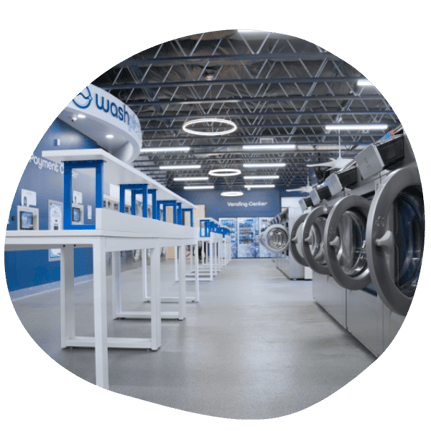 Most new owners buy an existing location or retool. Dimitri and Jeff went the other direction. "Out of the dozens of locations we saw available for sale, there really wasn't one that offered the value," Dimitri explains. "Even if the numbers made sense, the store was still stuck in the old world style. And there are variables you can't change: the location, the geography, the shape of the building."
So they decided to find a standalone building and build from scratch, a path everyone warned them would be the hardest way to go.
The location search took about six months. In the Bay Area, the word "laundromat" was often a dealbreaker with landlords. "If they hear the word laundromat, you're out," Dimitri says. "We had to put together a portfolio of renderings to show our vision before anyone would even consider us."
The Starbucks Standard
Dimitri and Jeff leaned on their engineering backgrounds to design the store, but they were the first to admit their limits. "Don't reinvent the wheel. Go out there and see what works and what doesn't," Dimitri says. "We're not artists or designers. But someone out there has already figured out what great looks like, so go learn from them."
They spent months visiting laundromats locally and across the country, studying aesthetics, materials, and layouts. But ultimately, they wanted to build something that was entirely their own, a concept that represented them.
Three priorities emerged from their research. First, space. "I would do mystery shopping at other laundromats and customers had no room to move around while unloading their machines. Space was key." Second, light and airy interiors. Third, materials that stay clean and don't chip, flake, or trap dirt over time.
But the guiding principle was a simple analogy. "Our target is Starbucks," Dimitri explains. "You can have your banker next door come in with a suit and tie and order a coffee and it's a very comfortable environment. And you can have the gardener that's just mowing the grass across the street come in and have their coffee. They equally coexist in a space that's comfortable. It's not underwhelming and it's not really overwhelming." The goal was a laundromat that welcomes everyone.
The Decision: Why Cents & Laundroworks
.png?width=341&height=341&name=WashPlus%20(2).png) Dimitri evaluated several technology vendors before choosing Cents and Laundroworks. His decision came down to three things.
Dimitri evaluated several technology vendors before choosing Cents and Laundroworks. His decision came down to three things.
Technology-first thinking. "A lot of vendors in this space were laundry proficient, but not technology proficient. The first thing I noticed about Cents is that they were technology proficient. If you are technology proficient, you can learn laundry. But if you know laundry, you can't necessarily learn technology. And they clearly know both."
A complete solution. "Once I saw that Cents and Laundroworks were under the same platform, I said, now they've got a complete solution for the customer. An established payment system paired with the software to run your entire operation."
The team. "The energy of the Cents team stands out. They've attracted a young, energetic group of people from all facets that it's been a pleasure to interact with. I've never seen so many young people get so excited about laundry."
The First 60 Days
.png?width=295&height=295&name=WashPlus%20(3).png) The final stretch before opening was a sprint. "Our project was well-paced until the end where it had to be a slam dunk," Dimitri says. To prepare his team, he dedicated a full week before opening to hands-on training. Rather than running through tutorials, he had staff bring in their own laundry and process it through every step: the machines, the Laundroworks payment system, and the Cents POS for wash-dry-fold orders. "The best way to teach the team how to use the system was actually having them bring in their laundry and process it." The Cents team also came on-site for an in-person implementation session.
The final stretch before opening was a sprint. "Our project was well-paced until the end where it had to be a slam dunk," Dimitri says. To prepare his team, he dedicated a full week before opening to hands-on training. Rather than running through tutorials, he had staff bring in their own laundry and process it through every step: the machines, the Laundroworks payment system, and the Cents POS for wash-dry-fold orders. "The best way to teach the team how to use the system was actually having them bring in their laundry and process it." The Cents team also came on-site for an in-person implementation session.
He also prioritized card registration from day one. "Every customer was walked through the kiosk setup. We told them, register your card for your own protection first, but you'll also get equipment notifications and promotions from us down the road."
The learning curve was real. The Electrolux Clara touchscreen machines were the first of their type in the Bay Area, so customers needed guidance. Small issues had to be troubleshot on the fly. "There's always a solution for everything, and we had to learn those things," Dimitri says. The Laundroworks payment system became second nature within a week or two. The Cents POS took a bit longer, since wash-dry-fold orders came in more gradually.
Looking back, Dimitri says he would have invested even more time upfront. "If I could do it all over again, I would have spent twice as much time on training."
He's been in the laundromat almost daily since opening, but has recently reached a point where he trusts his team to operate independently. "I've had confidence now for several weeks that when I'm not here, things operate well. It's just those anomalies that happen. Until they come up and you find a way around them, you don't know."
Creating a New Laundromat User
One of the most surprising early discoveries has been the type of customer walking through the door. "I think we actually have created a new laundromat user," Dimitri says.
.png?width=271&height=271&name=WashPlus%20(4).png) Beyond the traditional laundromat customer, Dimitri is seeing people who have laundry options at home but prefer the speed and experience of Wash Plus Laundry. "One customer told us, I could stay home and do laundry for eight hours on my single machine, or I can come here and be done in two."
Beyond the traditional laundromat customer, Dimitri is seeing people who have laundry options at home but prefer the speed and experience of Wash Plus Laundry. "One customer told us, I could stay home and do laundry for eight hours on my single machine, or I can come here and be done in two."
The wash-dry-fold service is gaining traction steadily. What started with one or two orders in the first weeks has grown to a base of repeat customers, with new inquiries coming in daily. One recent family order totaled over 250 pounds across 18 bags. "That tells you this can be and will be a significant part of the business," Dimitri says.
He sees potential in pickup and delivery too, but is clear-eyed about the operational difference. "Pickup and delivery is a completely different business with real operational overhead. You've got to be prepared to understand that and manage it. The wash-dry-fold drop-off is an ancillary service handled by the same crew that's already here."
"We're still learning every day," he adds. "Every customer who walks in teaches us something about what motivates people to come here, and we're adjusting accordingly."
The Future
Dimitri and Jeff are already looking ahead. Jeff has been evaluating future sites, meeting with potential investors and operators, and laying the groundwork for brand expansion. Their target is the greater Bay Area, within about a two-hour drive radius. "Being new, we want that proximity to develop the brand and the model," Dimitri explains.
For new operators entering the industry, Dimitri's advice is direct: "Do your due diligence. Talk to a lot of people and extract what works for you. There is no one cookie cutter formula for everybody." But if his own trajectory is any indication, the formula starts with a clear vision and the right technology to back it up.