.png?width=2196&height=2196&name=OS%20(1).png)



.svg)

-3.png?width=224&height=213&name=Accelerate%20(2)-3.png)






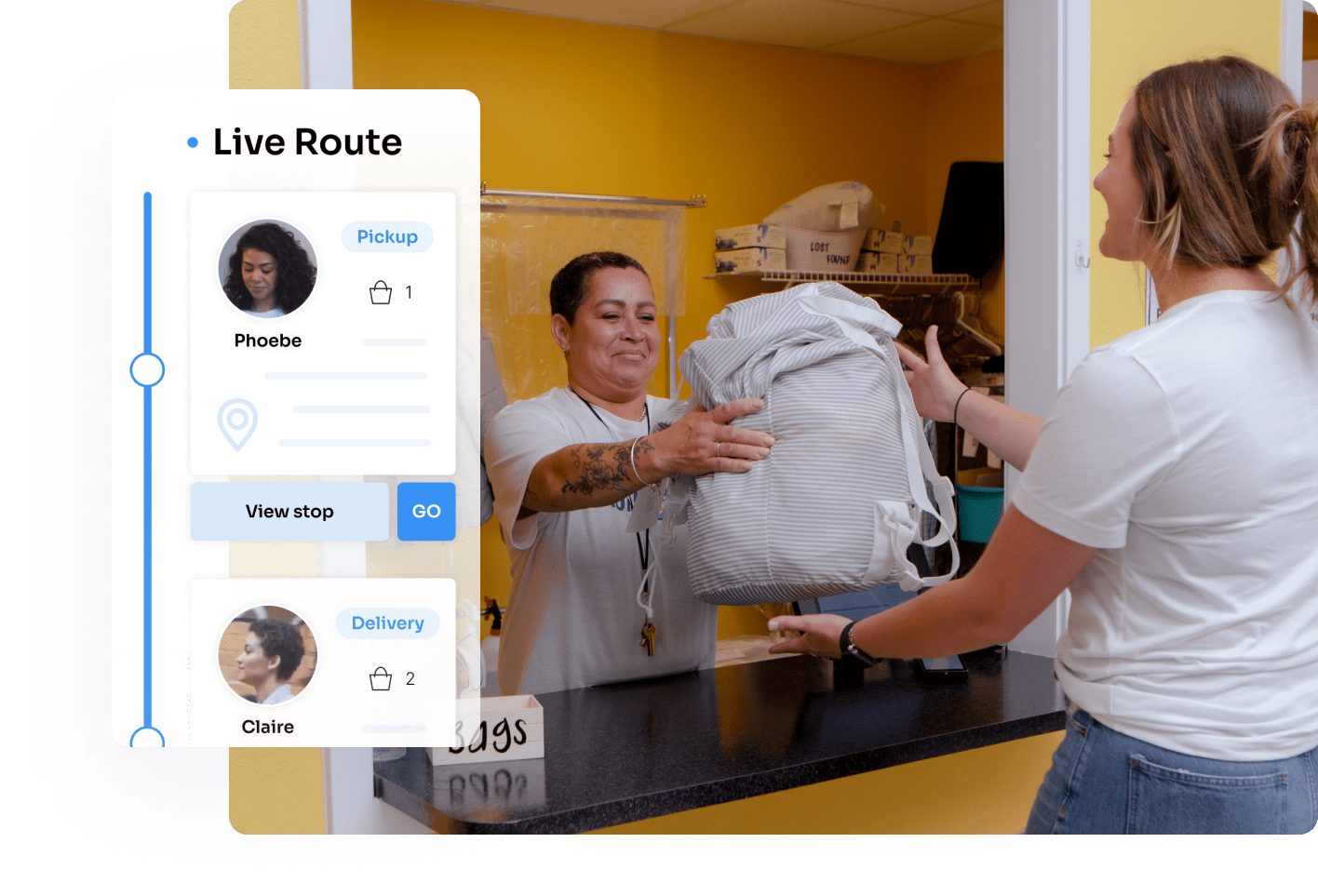


A customer texts at 2 AM asking about pickup hours. Your AI agent replies, confirms the window, and sends the order link. You wake up to a new order in your queue.
That's not a future scenario. It's what operators using today's AI tools are already experiencing.
If you've been hearing a lot about AI agents lately and aren't sure how they're different from the software you already use, here's the short version: most tools tell you what's happening in your business. AI agents actually do something about it.
What Makes an AI Agent Different
A basic chatbot reacts. You ask a question, it gives an answer, the conversation ends. It works fine for simple FAQs, but it can't actually do anything beyond that. It doesn't know what happened before, it can't take action, and it definitely can't follow up.
An AI agent acts. It takes in information, makes decisions, and completes tasks across multiple systems without waiting for someone to approve each step. It remembers context. It knows your customers, your orders, your pricing, and your services. And it uses all of that to get things done.
Think about the difference between a sign on your door that says "orders take 24 hours" and a staff member who looks up a specific customer's order, tells them it'll be ready by 3 PM, and texts them when it's done. One is static information. The other is actually working.
That's what an AI agent is. It's not a smarter FAQ page. It's closer to a team member with a very specific job, one it does consistently, at any hour, without dropping the ball.
In a laundromat context, that might mean answering a call at midnight and placing an order. It might mean noticing a customer hasn't visited in six weeks and sending them a win-back offer automatically. It might mean flagging that one of your machines is running slower than usual before it goes down on a busy weekend.
That's what's changed. AI agents aren't just answering questions. They're handling the work.
What AI Agents Are Doing Inside Laundromats Right Now
Handling customer calls, texts, and chat around the clock
Most laundromats field the same questions all day: What are your hours? How much is a large wash? Is my order ready? Can I place a pickup order?
An AI customer service agent handles all of that across phone, text, and website chat, without your staff stopping what they're doing. It knows your pricing, your services, your hours, and the status of current orders. It responds immediately, every time, and it doesn't put anyone on hold to go check something.
For multi-location operators, this is especially useful. Instead of managing separate phone lines and staff across stores, one AI agent handles it all from a single system.
Sharing live order status and taking new orders
Order status calls are probably the most common thing wash-and-fold operations deal with. A customer drops off a bag, then calls twice before 5 PM to see if it's ready.
An AI order agent connects directly to your point-of-sale system and pulls live order data. When a customer calls or texts, the agent checks the order and tells them exactly where it stands. If they want to place a new order, the agent texts them the link to do it. No staff involved.
Adjusting pricing based on demand
Most laundromats charge the same rate on a slow Tuesday afternoon as they do on a packed Saturday morning. That leaves money on the table in both directions.
AI-powered dynamic pricing agents track foot traffic patterns and machine usage, then adjust pricing automatically. Higher rates when demand is high, lower rates when it's slow. Ride-sharing platforms have used this model to increase revenue and laundromats are starting to apply the same logic. You set the price floors and ceilings. The agent handles the rest.
Flagging machine problems before they become breakdowns
A broken washer on a Saturday morning doesn't just cost you a repair bill. It costs you revenue, reputation, and usually a few one-star reviews.
Predictive maintenance agents monitor machine sensor data continuously, things like vibration levels, cycle times, temperature, and error codes. When something starts trending in the wrong direction, the agent flags it before the machine goes down.
Reordering supplies automatically
Running low on detergent mid-Friday is the kind of problem that shouldn't happen. But it does, because supply tracking is manual and easy to deprioritize when the store is busy.
Inventory AI agents track usage in real time and trigger a reorder automatically when stock drops below a set threshold. Detergent, laundry bags, dryer sheets, whatever you're selling or using on the floor. It monitors everything and reorders before you're scrambling. No spreadsheets, no manual counts.
Sending the right promotion to the right customer
Most marketing feels like throwing things at a wall. AI marketing agents do the opposite: they analyze customer behavior and find patterns, like which customers are close to signing up for a membership, or who hasn't been in for 45 days and might respond to a discount.
Then they act on it automatically. Personalized texts, re-engagement campaigns, loyalty rewards, all triggered by what the data says, not by you remembering to send something. Open rates go up and customers come back more often.
Cents Accelerate does exactly this inside your existing customer data. It can schedule messages based on behavior, segments your list automatically, and tracks who's opening, clicking, and converting, without you building a single campaign from scratch.
Understanding what your data is actually telling you
Most laundromat owners have more data than they realize. Order volume, peak hours, customer return rates, revenue by service type. The problem isn't that the information doesn't exist. It's that there's no time to dig through it.
Data insights agents surface that information automatically. Instead of pulling reports manually, you get a clear view of what's working, what's not, and where the opportunities are. Which services are growing. Which customer segments are slipping. What your busiest windows actually look like versus what you assumed.
That kind of visibility used to require a spreadsheet habit or a dedicated manager. Now it lives in your dashboard.
Looking up laundry card balances on demand
For stores running card-based payment systems, balance inquiries pull your staff away from customers all day. Someone calls, an attendant stops to look it up, everyone waits.
An AI agent connected to your card system handles this on its own. Customer texts or calls, agent pulls the account, reads the balance, done. No one else needed in the loop.
Three AI Agents Built Specifically for Laundromats
We built three AI agents directly into the Cents platform, each handling a different part of your operation.
Cents Assist: Your AI customer service agent
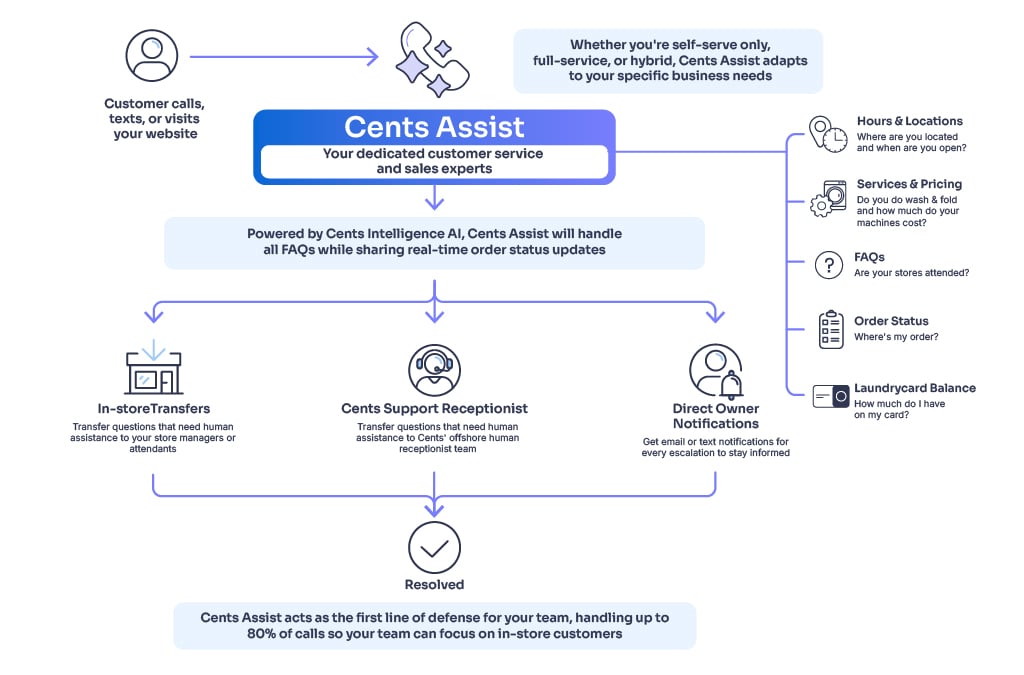
Cents Assist is your AI receptionist team, built for laundry businesses from the ground up. Not a generic chatbot you configure with FAQs. It has a built-in understanding of laundry terminology, garment care, service types, and the day-to-day workflows operators actually deal with.
Here's what it handles:
-
Calls, texts, and website chat from a single system
-
Live order status pulled directly from your Cents platform
-
New order processing over the phone or via text, including sending the order link on demand
-
Laundroworks laundry card balance lookups on demand
-
Customer service in English, Spanish, and additional languages
-
24/7 coverage including nights, weekends, and holidays
-
Smart call escalation with options to route to your staff, the Cents support team, or straight to you via text with a summary of the call
-
Centralized handling across all your locations
The result is a reduction in in-store call volume of up to 80 percent. Four out of every five calls your team would have fielded, handled automatically.
Brian Riseland of Laundry Genius put it plainly:
"Before Cents Assist, we were missing calls simply because we needed to prioritize customers standing right in front of us. Since implementing the system, we've seen a direct impact on our bottom line. The system's 100% answer rate means we never miss an opportunity, and customers receive professionalized, consistent information."
Aprill and Shane Ashley of Freedom from Laundry were managing five phones across their operation before switching to Cents Assist. Daily call volume dropped from 50 calls to 10. The agent handled the rest.
Cents Accelerate: Your AI marketing agent
Cents Accelerate is the marketing agent built into your Cents dashboard. It works off the customer data you already have, no additional setup or list building required.
It schedules personalized email and SMS campaigns based on customer behavior, automatically segments your audience, triggers re-engagement messages for lapsed customers, and tracks performance across every campaign. If you want to send a promotion to your VIP group, or set up an automated welcome flow for new customers, Accelerate handles it. You can use Cents pre-built templates or bring your own branding. Either way, the campaigns run without you having to manage them manually.
Business Manager: Your AI data insights agent
The Cents Business Manager is where your operation data lives, and the data insights built into it act like an agent that's always watching the numbers so you don't have to.
From any device, you get a real-time view of active orders, completed transactions, machine activity, and revenue across all your locations. Monthly sales, customer counts, and order trends are surfaced automatically. When you want to go deeper, there are over 100 reports available. The point isn't just visibility. It's that the data is organized and ready to act on, whether you're on the floor or checking in remotely.
Together, these three agents cover the parts of your business that consume the most time without directly adding value: answering phones, running campaigns, and making sense of your numbers.
Why This Year Specifically
The technology has been developing for a while. But 2026 is when the tools got accessible enough, and the competitive pressure got real enough, that sitting it out has a cost.
Customer expectations have shifted. The person who expects an immediate response from a food delivery app now expects the same from your wash-and-fold service. If a competitor down the street answers every call at midnight and yours goes to voicemail, the customer doesn't usually try again. They book with the other store.
On the adoption side, enterprise research from late 2025 found that 90 percent of businesses are actively adopting AI agents, and 79 percent expect full-scale deployment within three years. That's not a laundromat-specific number, but the same tools are showing up in the industry now, and the operators getting comfortable with them early are building an advantage that will be harder to close later.
A Note on Your Staff
The most common concern operators raise: does this mean fewer people on the floor?
Not really. What it means is that your people spend less time on the phone and more time with the customers who are actually in front of them. Attendants can focus on service instead of fielding balance inquiries all shift. Managers can spend time on the floor instead of handling calls from their back office.
The laundromats getting the most out of AI agents aren't replacing people. They're freeing up their people to do things AI genuinely cannot, like reading a difficult customer situation, building the kind of rapport that keeps someone loyal for years, or making a judgment call that no script accounts for.
Where to Start
If none of this is in place yet, a useful first step is to track where your time and your team's time actually goes on a normal day.
How many calls are you handling? How many are the same questions repeated across different customers? How many opportunities are slipping through after hours when there's no one available to answer?
That's the gap an AI agent closes. And in 2026, closing it is quickly becoming the baseline for running a competitive laundromat.
Schedule a demo to see how Cents AI agents work for your laundromat.