.png?width=2196&height=2196&name=OS%20(1).png)



.svg)

-3.png?width=224&height=213&name=Accelerate%20(2)-3.png)









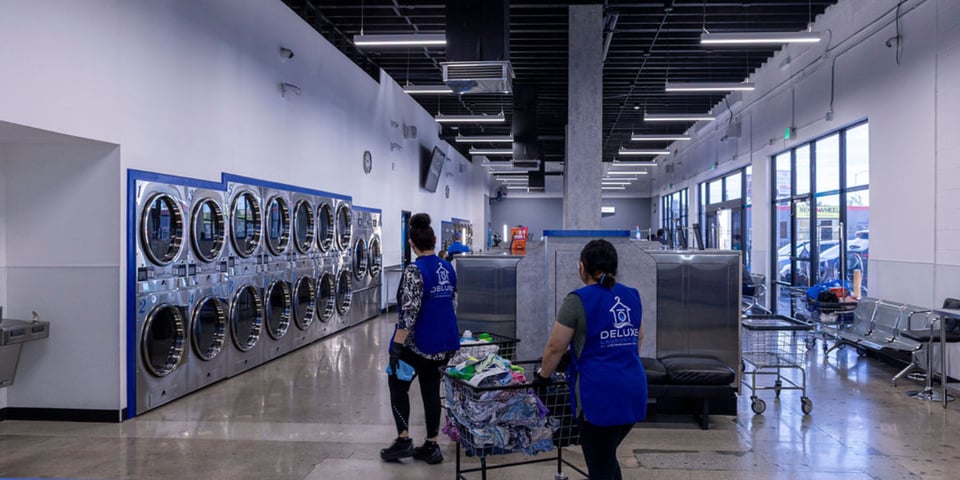
There is a version of laundromat automation that a lot of operators imagine when they hear the word, and it is not great. They picture a sterile, fully unattended store where machines accept payments and nobody is around to help when something goes wrong. Cold. Impersonal. Maybe even a little depressing.
That is not what modern automation looks like, and it is definitely not what the most successful operators are doing in 2026.
The real opportunity is not about removing people from your business. It is about removing the repetitive, low-value tasks that keep your people from doing the things that actually grow your business: building relationships with customers, upselling services, maintaining a clean and welcoming store, and solving problems that need a human brain.
The laundromat industry has gone through more change in the last year than in the previous decade. Consolidation is accelerating. New investors are entering the market. Customer expectations are rising. And operators who are not adapting are finding the competitive landscape a lot less forgiving than it used to be.
So let us talk about what laundromat automation actually looks like when you do it right.
Start with Your Biggest Time Drain: The Phone
If you had to guess the single most disruptive part of running a laundromat day to day, it probably would not be the equipment or the folding or even the delivery logistics. It is the phone.
Every time the phone rings, somebody has to stop what they are doing. If they are helping an in-store customer, that in-store customer waits. If nobody picks up, industry data tells us that 85% of those callers are gone for good. And the questions those callers are asking? The vast majority are repetitive: What are your hours? How much is wash and fold? Where is my order? Can I check my card balance?
This is the first place most operators should automate, and it is where the ROI is most immediate.
Cents Assist handles this by acting as an AI receptionist team that sits between your customers and your store. It answers calls, texts, and website chats 24/7. It knows your pricing, your hours, your services. It can check a Laundroworks card balance in real time, share order status, and even text customers a link to place a new order. For the calls that genuinely need a human, you set the escalation rules: transfer to the store, send a text to the owner, or route to a support team.
Operators using Cents Assist typically see an 80% reduction in calls that reach their in-store team. That is not a marginal improvement. That is your attendant getting hours of productive time back every single day.
Automate Payments (and Say Goodbye to Quarters)
If your machines still only accept coins, you are making life harder for your customers and yourself. The shift to cashless payment systems has been one of the most significant operational changes in the laundromat industry over the past five years, and it is accelerating.
Card-based and mobile payment systems like Laundroworks eliminate the need for coin changers, reduce vandalism and theft risk, and give you the ability to adjust pricing remotely. They also generate data: which machines are being used most, when your peak hours are, what your average transaction looks like. That information is gold when you are trying to optimize your business.
The equipment side of the industry is moving fast too. Smart washers and dryers with IoT connectivity and remote monitoring are becoming standard in new builds. Manufacturers are rolling out machines with predictive maintenance alerts, real-time energy monitoring, and automatic cycle optimization. Dexter, Alliance, and Electrolux Professional are all pushing deeper into connected equipment that talks to your management platform.
The key is making sure your payment system and your management platform actually talk to each other. When Cents and Laundroworks work together, for example, you get a unified view of your business: orders, payments, machine activity, and customer data all in one place.
Automate Order Management and Delivery Logistics
Wash-dry-fold and pickup and delivery have become the highest-margin revenue streams for many laundromat operators. But they are also the most operationally complex. Managing incoming orders, tracking garments, routing drivers, and communicating with customers throughout the process can eat up an enormous amount of time if you are doing it manually.
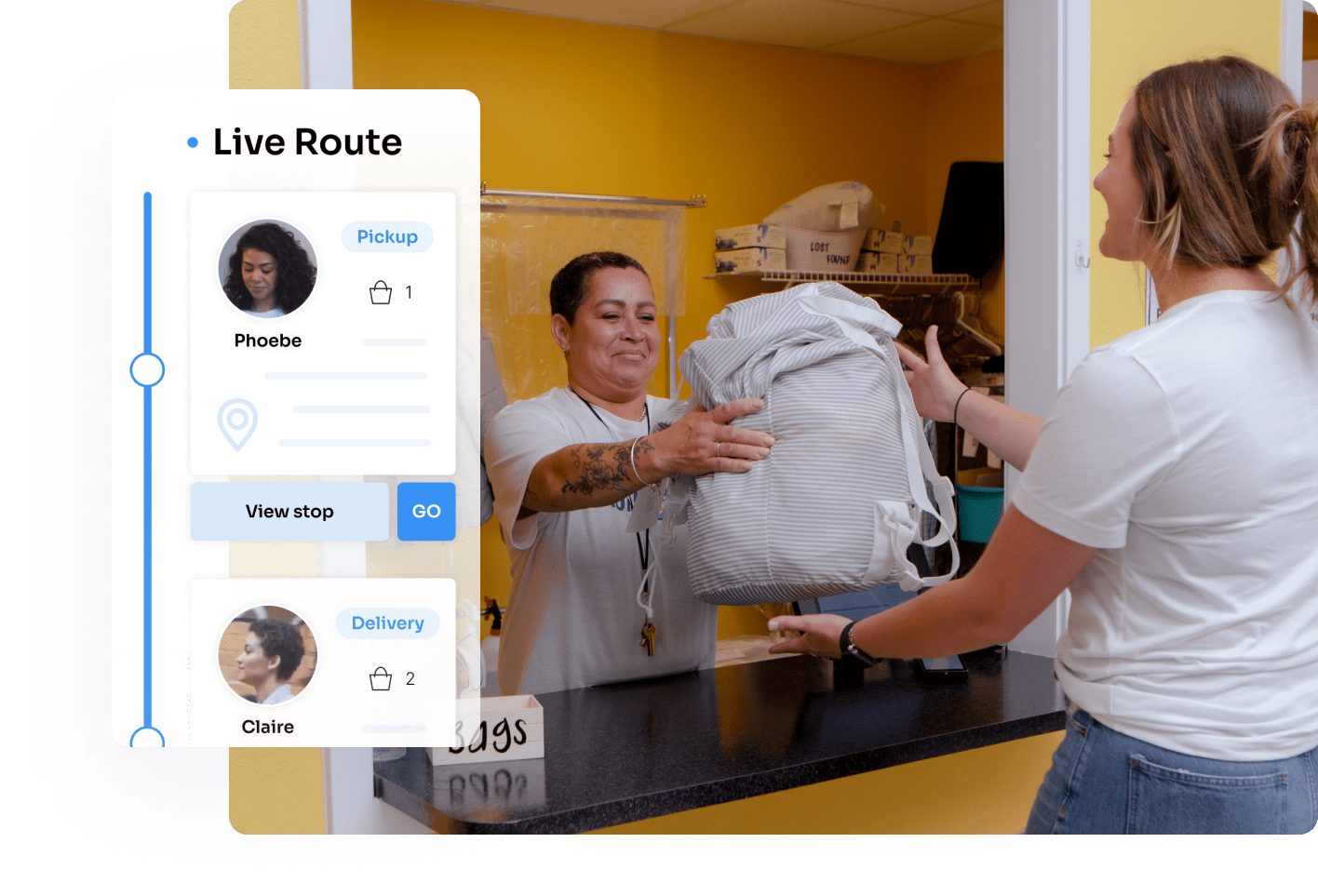
A platform like Cents handles the entire workflow: online order intake, POS processing for drop-offs, driver dispatch and route management, and automated customer notifications. When you layer Cents Assist on top of that, customers can check on their own orders by calling or texting without your team lifting a finger.
This matters because the demand for convenience in laundry services is not slowing down. IBISWorld pegged the U.S. laundromat industry at $7.1 billion in 2026, and operators adding delivery and full-service options are capturing a larger share of that. But you cannot scale service-based revenue streams with manual processes and sticky notes. You need systems.
Automate Customer Communication
Beyond the phone, there are dozens of routine customer touch points that can and should be automated. Order confirmations. Pickup reminders. Delivery ETAs. Membership renewal notices. Loyalty program updates.
These are not the kind of communications that necesarily need a personal touch. They need to be timely, accurate, and consistent. Automation handles this perfectly, and it creates a customer experience that feels more professional than most laundromats deliver today.
For self-service operators who are not running WDF or delivery, automation still matters. Website chat can answer questions for walk-in customers before they even arrive. Text-based communication can handle machine status inquiries. And your AI receptionist can be configured to turn off any mention of pickup and delivery so it only discusses the services you actually offer.
The Small Business AI Tipping Point
It is worth stepping back and looking at the broader landscape here. Small business AI adoption has surged. The U.S. Chamber of Commerce and Teneo found that 58% of small businesses were using generative AI in 2025, up from about 40% the year before. A Thryv survey found that usage among businesses with 10 to 100 employees jumped from 47% to 68%. McKinsey reported that 88% of organizations used AI in at least one business function by mid-2025.
The laundromat industry is not immune to this trend. If anything, it is a sector that stands to benefit disproportionately because the operational challenges, like staffing, phone management, and multi-location oversight, map so directly onto what AI tools are good at.
The Thryv data also found that 80% of small business AI users believe the technology is essential to reaching new customers, and 67% say it takes real pressure off themselves and their staff. For a laundromat owner who is already stretched thin managing operations, marketing, maintenance, and customer service, that kind of relief is not theoretical. It is immediate.
A Practical Automation Roadmap for Laundromat Operators
You do not have to automate everything at once. In fact, the most successful small businesses adopt AI and automation in phases, starting with one high-impact area, measuring for 90 days, and expanding from there. Here is a realistic sequence for most laundromat operators:
Phase 1: Phone and customer communication. Implement an AI receptionist like Cents Assist to handle calls, texts, and website chat. This has the fastest ROI because you start capturing missed revenue immediately and your staff gets time back on day one.
Phase 2: Payments and machine management. Move to a card-based or mobile payment system that integrates with your POS. Get visibility into machine usage, peak hours, and revenue by machine. This is where your operational data starts working for you.
Phase 3: Order management and delivery. If you offer wash-and-fold or pickup and delivery, bring those workflows into a centralized platform. Automate order tracking, customer notifications, and driver dispatch. This is how you scale service revenue without scaling headcount.
Phase 4: Analytics and optimization. Once you have data flowing from your payment systems, POS, and AI receptionist, you can start making smarter decisions about pricing, staffing, marketing, and maintenance. This is the compounding effect of automation: each layer makes the next one more valuable.
Automation Is Not About Replacing People
One of the biggest misconceptions about laundromat automation is that it means going fully unattended. For most operators, the goal is not to eliminate staff. It is to make your staff dramatically more effective.
When your attendant is not answering the same five questions on the phone all day, they can focus on upselling services, keeping the store spotless, and building the kind of face-to-face relationships that turn first-time visitors into regulars. When your AI handles the routine, your humans handle the exceptional.
That is the competitive advantage. Not automation for the sake of automation, but automation that frees up the people and processes that make your laundromat worth choosing.
Think your customers would not talk to an AI? Try it yourself. Demo Cents Assist, call the AI receptionist, and throw your toughest customer questions at it. Most operators are surprised how quickly it feels like talking to a real team member.
.png?width=400&height=200&name=blog%20banner%20(4).png)