.png?width=2196&height=2196&name=OS%20(1).png)



.svg)

-3.png?width=224&height=213&name=Accelerate%20(2)-3.png)









As an operator who has witnessed and shaped three decades of industry evolution, Rob Bodner's journey from McDonald's playground installer to laundromat innovator reveals a fundamental truth: the best operators don't just adopt technology—they continuously evolve with it. Operating multiple locations across New Jersey while maintaining residency in Florida, Rob has built a business model that prioritizes automation, strategic innovation, and operational excellence over industry convention.
His approach? Be the early adopter while everyone else hesitates. "I look at other people's reluctance as my opportunity," Rob states simply.
The Problem-Solving Foundation
.png?width=301&height=301&name=Great%20Laundry%20(5).png) Rob's path to becoming one of the industry's most forward-thinking operators began in the quick-service restaurant space. Working in the McDonald's ecosystem, Rob learned a fundamental lesson that would shape his entire approach to business.
Rob's path to becoming one of the industry's most forward-thinking operators began in the quick-service restaurant space. Working in the McDonald's ecosystem, Rob learned a fundamental lesson that would shape his entire approach to business.
"Don't push products, solve problems, understand their business," Rob explains. "When you get past that, people trust you to do business. That's my philosophy."
This problem-solving mindset—combined with exposure to the highly systematized world of McDonald's franchises—would prove essential when Rob entered the laundromat industry in the mid-1990s. Like most operators starting out, Rob began with traditional coin operations. But unlike most operators, he was already planning his exit from coins.
"When I originally started looking at laundromats, I explored a franchise opportunity where all their stores used card systems," Rob explains. "I had that concept in mind long before I even got into the business because of the accountability and not having to deal with coins."
The daily reality of coin operations only reinforced his conviction. Constantly refilling change machines, emptying coin boxes every Sunday, managing the weight, dirt, and security concerns of cash—it was exactly the inefficiency Rob's QSR background had trained him to eliminate.
After twelve years of coin operations, Rob was ready for change. But first, he needed to prove what he suspected was happening behind the scenes.
From Early Card Systems to Laundroworks
In the mid-1990s, Rob became one of the earliest adopters of card-based payments in the industry.
"I bought the smart card systems early on because I realized—besides coins being dirty, heavy, and unsafe, and having to buy them, pay to have them brought back, and make sure they're counted—I was losing coins. I attributed a lot of that to merchants coming in to get change."
The results of the renovation were stunning and definitive.
"I had a very large increase in business. Yet my utility bills and water didn't change much—just a little bit," Rob explains. "So what does that tell you? I was being stolen from."
Without coins to skim, his actual revenue finally matched his operational capacity. The revelation cemented Rob's philosophy: "That led me on the journey that I would not be in this business if it wasn't for automation. Even in the beginning, it fit my vision of what a business should be."
This early adoption of card-based payment systems in the mid-1990s set Rob apart in an industry where many operators still resist abandoning coins decades later. But Rob's commitment to staying ahead didn't stop there. Over his career spanning more than 100 projects and ownership in over 30 stores, he's been through half a dozen point-of-sale systems, always searching for the right combination of reliability, functionality, and ease of use.
Eventually, Rob found what he was looking for in Laundroworks for machine payments. Rob valued rock-solid reliability and practical functionality—and Laundroworks delivered on both.
"It's not very sexy as far as the reader and everything else," he admits. "However, what I realized is nobody cares. I have electronic displays on the machines, but it's really functional. The other thing that's nice is there's no threat of things getting caught and jamming. It's been a very stable system."
The decision also came down to working with a company that understood customer service—and that commitment hasn't changed. "Laundroworks has been terrific to do business with. Very easy compared to other companies in this business. The support has been great and continues to be great."
Rob has remained a loyal Laundroworks user for years, appreciating the system's stability and the company's responsiveness. His customers adapted quickly to the card-based system, particularly his regular clientele who appreciated the convenience and consistency.
"People have adapted well," Rob notes. "You'll get a few customers who say they want to put money directly in the machine, but that's a very small number. Usually if you train a few people, word travels pretty quickly."
But as Rob's operation grew more sophisticated and he split his time between Florida and New Jersey, he identified a gap: he needed better integrated visibility and remote management capabilities to complement his Laundroworks system.
The Missing Piece: Integrated Operations Management
Operating multiple locations while living in Florida created a challenge that even his trusted Laundroworks system couldn't fully solve alone. Rob needed comprehensive oversight—the ability to monitor not just machine payments, but wash-and-fold operations, employee performance, and overall store health from anywhere.
The solution came through recently integrating the Cents point-of-sale system with his existing Laundroworks infrastructure. Cents offered true operational integration that would work seamlessly with his established Laundroworks payments.
"With the two systems together, it enables me to do a lot," Rob emphasizes. "I'm in the business manager every day, but I don't have to be in the store. I look at my reports like someone who's a trader watching the market—figuring out what days are good, what times are good. Each store is a little different, like children."
The integration also improved customer experience. Cents enables text alerts for wash-and-fold customers, reducing phone calls and providing updates automatically—another layer of automation that only works because both systems communicate seamlessly.
This integrated approach would prove essential when Rob opened his most ambitious project yet.
Building a Showpiece: The West Orange Store

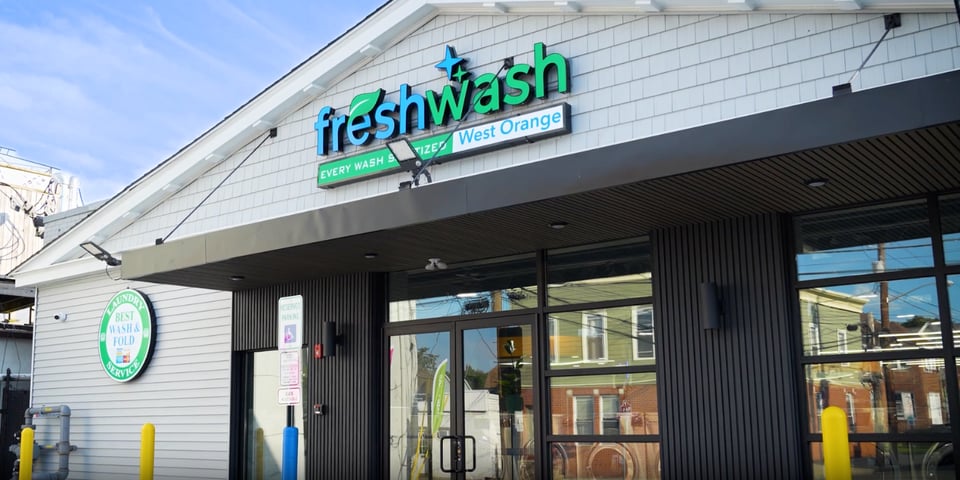
In summer 2025, Rob's vision fully materialized in his West Orange location—a stunning 6,000-square-foot store that has become a crowd favorite among Cents employees.
But Rob's design philosophy goes deeper than aesthetics. While the industry trends toward loud, overstimulating environments, Rob took a contrarian approach.
"Everybody seems to trend toward making it as loud as possible—same thing in restaurants. They play music really loud. You can't talk. Everything has to have a vibe," Rob observes. "People are already stressed out. You're going into stores and being overwhelmed by all your senses. I said, 'I'm not going to do that.'"
The result is a calm space that offers free coffee to all customers—not as a profit center, but as a gesture of hospitality. "It's free for everybody, it's free for our customers," Rob says simply.
The West Orange store serves as Rob's template going forward—a legacy asset owned by the family that will provide long-term cash flow and a model for potential expansion. But getting there, as Rob notes, "was like giving birth to a baby elephant."
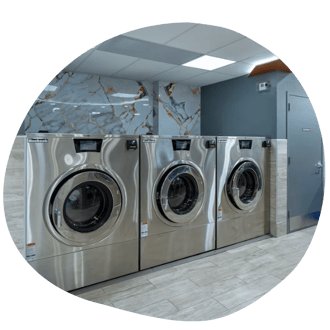
The store houses 107 machines and is equipped with the full technology stack: Laundroworks for reliable machine payments, Cents for comprehensive operational management including wash-and-fold tracking and text alerts, and surveillance cameras for security and operational monitoring—all accessible remotely from Florida.
Technology, Training, and Patient Growth
.png?width=401&height=401&name=Great%20Laundry%20(3).png) Rob is refreshingly honest about his technical limitations. His solution? Leverage the right people. His manager Adriana has been with him for 21 years, and her daughter, who is bilingual, handles system setup and trains employees in both English and Spanish.
Rob is refreshingly honest about his technical limitations. His solution? Leverage the right people. His manager Adriana has been with him for 21 years, and her daughter, who is bilingual, handles system setup and trains employees in both English and Spanish.
"Now if there's a problem, people call her," Rob explains. "When you have integration and the systems work together, you get stability."
That stability extends beyond technology. Rob has been blessed with hourly employees who have been with him for up to 15 years across multiple stores—a rarity in the industry that enables him operational freedom to continue developing other sites and enjoy life.
When opening West Orange, Rob deliberately skipped the grand opening fanfare. "I didn't put up an open sign for the first month," he recalls. "When people came in and asked if we were open, we'd say, 'Yeah, come on in.' It was just getting everybody used to the system—making it seamless."
This gradual approach allowed employees to master the integrated Cents and Laundroworks platforms before facing full capacity crowds. "We opened so soft that we could work out all the kinks with our infrastructure, our employees, everything—before we had the pressure of massive volume."
The same patience extends to service expansion. Despite having the capability, Rob's West Orange store doesn't even have vending machines yet. Wash-and-fold and delivery services will come when the data says it's time.
"It's like peeling an onion," he explains. "Before wash-and-fold, we need to know that people know how to take care of customers, the store is staying clean, my staff is fairly stable. What I'm looking for is stability, and the systems together allow me to do that."
The philosophy stems from hard-won experience. Rob recalls over-complicating early operations earlier in his career with indoor playgrounds and snack bars. "I said, 'No more. We're done with that.'"
His current approach: "Keep it simple, keep it good. At our core, we're a self-service laundromat. If we hit certain baselines, I'll go from there. Why spoil something good if I don't need to?"
The technology integration helps him evaluate opportunities methodically—the data tells him when he's ready to expand.
Building a Family Legacy Through Innovation
 This patient, technology-enabled approach isn't just about Rob's timeline—it's about building something his sons can inherit. At 68, Rob is building toward a succession plan centered on his sons—enabled entirely by the stable, technology-driven operations he's created.
None of it would have been possible without his wife Shelley, whose unconditional support over the years has been the foundation of everything Rob has built.
Steven, his oldest son who is on the autism spectrum, manages the 1,500-square-foot Parsippany location. The stable, well-systematized operation provides him with a manageable business environment suited to his strengths.
Rob's youngest son, Bryan, represents the next generation of expansion. With a Columbia MPA and high-level business experience, Bryan will join the operation to help scale the family business.
The West Orange store sits just 15 minutes from Steven's Parsippany location. The technology infrastructure—Laundroworks for payments, Cents for management, integrated surveillance—makes this distributed family management model possible while Rob splits time in Florida.
"I'm actually a Florida resident. I have somebody else to help and rely on, which would be nice for Steven as well. So that's kind of the master plan."
Lessons from Three Decades
.png?width=295&height=295&name=Great%20Laundry%20(2).png) For new operators, Rob's advice is direct: "Learn the business. Don't listen to what everybody tells you, because it's got to be a good fit for you. Embrace the technology if you want to have a quality of life and the ability to expand."
For new operators, Rob's advice is direct: "Learn the business. Don't listen to what everybody tells you, because it's got to be a good fit for you. Embrace the technology if you want to have a quality of life and the ability to expand."
He cautions against unrealistic expectations. "Don't expect that you can quit your job and make a living from this right from the outset. You have a lot to learn. Learn the business before you jump in with both feet." He also emphasizes planning an exit strategy from day one.
Rob is realistic about his timeline, though the industry keeps pulling him back. "Every time I think I'm going to get out, they pull me back in again," Rob jokes, referencing his consulting work and ongoing involvement.
Whatever comes next, technology remains central. "A simple business made complicated is becoming more simple through the advent of technology. There's a learning curve, but that's basically what I look for."
The real lesson from Rob's story isn't just about adopting technology—it's about continuous evolution. While many operators find a system and stick with it indefinitely, Rob has moved through half a dozen systems, always searching for the next improvement. His loyalty to Laundroworks comes from genuine satisfaction with reliability and service. His recent addition of Cents represents evolution—adding integrated management capabilities while maintaining the stable payment platform he trusts.
"I make mistakes. Don't think I got this nailed," Rob emphasizes. "But I've made my share of mistakes, and I've learned something from them. I still make them every day. The difference is, I keep trying to do things better."
For operators wondering whether to take the leap into modern payment systems or integrated management platforms, Rob's three decades offer a clear message: the risk isn't in adopting new technology too soon—it's in waiting too long while competitors gain advantages you'll never recover.
"I look at other people's reluctance as my opportunity," Rob says. "Where can I fit something here that they're not doing or seeing that I can do?"
After 30 years, six payment systems, over 100 projects, and ownership in more than 30 stores, Rob Bodner has proven that continuous innovation isn't just a philosophy—it's a competitive advantage that compounds over time.
.jpg?width=400&height=200&name=SUNBEACH%20(2).jpg)