.png?width=2196&height=2196&name=OS%20(1).png)



.svg)

-3.png?width=224&height=213&name=Accelerate%20(2)-3.png)








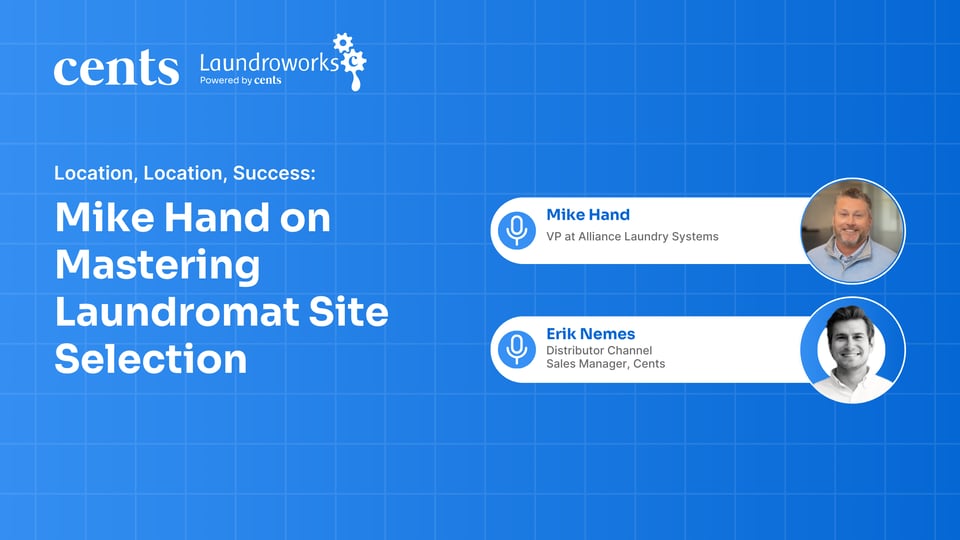
Erik Nemes, Distributor Channel Sales Manager for Cents and Laundroworks, and Mike Hand, Vice President of North America Commercial Central and East at Alliance Laundry Systems, delivered an essential masterclass at Clean Show 2025 addressing the single most critical factor in laundromat success: location. With 31 years in the industry and Alliance boasting a 95% success rate, Mike shared hard-won insights about what separates thriving laundromats from failed investments.
Key Takeaways:
-
The secret behind Alliance's 95% success rate—it's not what you think: While demographics matter, the real differentiator is Alliance's two-step distributor network providing intimate knowledge of local markets and real-time insights that no demographic report can capture, understanding nuances like whether a market is rebounding or declining that only locals would know.
-
Location mistakes cost hundreds of thousands—here's how to avoid them: The number one cause of laundromat failure is picking the wrong location, whether it's chasing cheaper rents in neighborhoods too deteriorated to support business or targeting areas too affluent to need the service, making partnership with a knowledgeable local distributor non-negotiable from day one.
-
The three pillars that predict location success: Demographics (renters, household income, population density), infrastructure (utilities, lease terms, public transportation), and competitive positioning all require evaluation—but must be filtered through local market intelligence since what works in Boston is completely different than California, Texas, or Ohio.
-
Real horror stories that could have been prevented: A perfect-looking location turned out to have a tension slab—hidden tension rods that would have destroyed the entire building if drilled into—discovered only after the customer invested hundreds of thousands and was 90% through permitting, highlighting why bringing in installers and experts during site evaluation (not after lease signing) is critical.
-
The laundromat demographic has completely evolved: The industry has shifted from small laundries serving less affluent communities to large operations targeting higher-income customers who value time over money, driving demand for wash-dry-fold and pickup delivery services and fundamentally changing site selection to include locations that would have been considered "too affluent" 20 years ago.
-
Don't rush—90 days of learning beats years of regret: Before signing anything, spend three months attending industry events, talking to existing owners, and becoming a vacuum for information, because the right location with the right distributor partner is worth waiting for and excitement should never rush you into a bad decision
Mike and Erik's session drives home one fundamental truth: location isn't just important—it's everything. After 31 years of experience, Mike's advice is simple: don't rush, find the right distributor partner who knows your local market, and invest time learning the industry before signing anything. The number one reason laundromats fail is the wrong location—and that's the one thing you can't fix later.
Erik Nemes 00:00: Hello everyone, appreciate you attending our session. My name's Erik Nemes. I'm the Distributor Channel Sales Manager for Cents and LaundroWorks. Today we're going to dive deep into one of the most critical factors in laundromat success - location selection. I'm joined by Mike Hand from Alliance Laundry Systems. Mike, if you want to give a quick introduction of yourself and your background at Alliance?
Mike Hand 00:30: Sure, thanks Erik. My name is Mike Hand. I'm the Vice President of North America Commercial Central and East at Alliance Laundry Systems. I've been in the laundry industry for 31 years - 95% of that on the distribution side. I worked for a local distributor in Columbus, Ohio for the first 24 years, spent five years in Texas helping with a startup, and now I've been with Alliance for almost six years. Throughout my career, I've always been affiliated with Alliance products through the distributors I've worked for or ran.
Erik Nemes 01:15: Awesome. Well Mike, I appreciate you joining us. We were just talking about how busy everything has been. So we'll try to get this information out for everyone. Mike, Alliance boasts an impressive 95% success rate with laundromat locations. What are the core demographic criteria that predict this level of success?
Mike Hand 01:35: Yeah, I think, you know, it's in addition to demographic. So you always look for a number of renters, median household incomes, you know, traffic patterns. But in addition to that, part of our success and laundry owner success is built upon the fact that working through our distributor network, I think our distributor network doesn't get enough credit for what they do. Alliance, you know, gets that 95% success rate. But we couldn't do it without our two-step distribution, as well as our company of distributors. They're the ones with boots on the ground, intimate knowledge of local markets, and real-time insights that no demographic report can provide.
Erik Nemes 02:20: Yeah, and working with distributors, the local distributors daily, I can attest they know their markets, they're smart, they know what works. So they've been a great resource for us and also for their investors and customers to help them grow. Some of the other things that I know we've talked about in the past with demographics, looking at the infrastructure, competitive positioning - you mentioned demographics, infrastructure, and competitive positioning as the three pillars. Can you walk us through how you evaluate each of these categories?
Mike Hand 02:50: Yeah, I'm going to sound like a broken record here - distributors. We look at demographics, we look at proformas, we look at trends in the market. All these things we couldn't do without a distributor. It's in my opinion, 31 years of doing this, it's the most important piece is to partner yourself with somebody who's got intimate knowledge of the local market where you're looking to build your store. We can put spreadsheets together. We can pull demographics. We can look at everything. The one thing we don't know at Alliance without local representation is what are those trends? You know, is this market coming back up? Has it been down? You know, things like that. Those nuances that only someone living and working in that market every day would know.
Erik Nemes 03:45: Yeah, and I think I'm fairly new to the industry, but it was pretty eye-opening for me talking to distributors in Boston and California. It's just different. The industry is just different. So having that local team that knows the market is absolutely key. We've talked a lot about success, but we know mistakes happen as well. What are some of the most common and costly site selection mistakes you see operators making, and how does Alliance's methodology help avoid them?
Mike Hand 04:15: I think the common mistake is picking the wrong location, right? Location is really important in our industry. Folks have picked locations that, you know, may be a lower investment to get in, cheaper rents. You know, the neighborhood's just too bad. It won't support a laundry. The neighborhood's, you know, too high net worth. It won't support a laundry. I think the number one mistake that people make with a bad laundry is finding the wrong location. It's the number one - it would be my biggest - I was just talking to the gentleman in the back of the room and he asked, you know, new guy coming into this, what's the best advice you can give me? Find the right location, partner with the right distributor who knows your market, because like you said, every market is different. What works in Boston is completely different from California or Texas or Ohio. The number one mistake in a failed laundry is finding the wrong location. That's it. Location, location, location.
Erik Nemes 05:15: Yeah, absolutely. And when it comes to finding that right location, when evaluating infrastructure, what are the non-negotiable requirements that can make or break a location's viability?
Mike Hand 05:25: Yeah, I mean, I think it's population, it's renters, it's fair market value for rent, it's the length of the lease, it's, you know, is there public transportation coming down? You know, do you have businesses? Are there rooftops all over that are, you know, 60% renters and high density? But, you know, the demographic of the laundry user has changed a lot too. As you look at it, the most valuable asset we have as human beings is time. So the days of, you know, people using a laundry who didn't have their own laundry, it's no longer that. It's also people who want some of their time back, you know, that's why you see wash-dry-fold, pick up delivery and those things. So these are all things, you know, when you look for a location, what's your business plan? What do you want to be part of? Is it wash-dry-fold? Is it pick up delivery? You know, and partner with the right distributor to find a location that fits what you're trying to do because the demographic of the laundry user - 31 years of doing it - when I first came into the business, it was small laundries, providing a service for, you know, communities where they were maybe not as well off as others. Today, it's big laundries, higher population, higher income levels. So it's, you know, whatever your business plan is, partner with the right person and determine to pick that location. The infrastructure requirements will vary based on your business model.
Erik Nemes 07:00: Absolutely. And you know, competition is something everyone thinks about. How do you approach competitive analysis - are you looking to avoid competition or find opportunities within competitive markets?
Mike Hand 07:15: I think competition is healthy, right? But there is such a thing as bad competition. I would never recommend somebody putting a laundry next to somebody or across the street from somebody, right? There's enough business for everybody, but there's good business and bad business. It depends on the market too. So New York City, there's one on every corner. Columbus, Ohio, where I live, there isn't, you know, two and a half, three mile radius. Competition is tricky. You know, we utilize our finance team heavily when it comes to competition because we get one crack at it, right? And if we do it wrong the first time, we don't get a second, third and fourth. We have a finance department that will run everything, create a narrative, and they'll look and see if there is enough business in that market. So there's good competition, there's bad competition. There's a lot of, you know, old stores that need retooled. People still go to them. That shows you that there is a need for a laundry in that market, right? Not necessarily right next door, but in proximity. So I think that, you know, the reality is competition is good, competition is healthy, but it's got to be the right location. It all goes back to location. It all goes back, and that sounds like a broken record, but it goes back to location and having a distributor or somebody who knows that market to find you the right spot. We don't want to build stores on top of stores. Saturation isn't good for any laundry owner, and at the end of the day, all laundry owners are in business to make money. They're not a not-for-profit, right?
Erik Nemes 09:00: Yeah, absolutely. And I'm sure every situation is a little bit different. But have you ever run into a time where you found the perfect location, everything looked like it was lining up, and then maybe you missed something or there was a hidden red flag that you didn't catch? Can you share a real example of a location that looked perfect on paper but had hidden red flags, and how your process identified them?
Mike Hand 09:25: Yeah, we had a store that we were building probably about four years ago, and we were 90% through the whole process of getting permits. And we found out it was built on a tension slab. We had the customer had plans drawn up. And for those who don't know what a tension slab is, it looked like it was a solid eight to 10 inches of concrete, but it had tension rods running from corner to corner. So if we would have drilled in, we could have broke the tension slab and essentially ruined the building and the other retailers that were in that building. So we missed it. It was something that was hidden. We didn't take an installer out there and take a sample of the floor. You know, part of a laundry that we put in had a basement in the back. It was a crawl space. We didn't get all that way back. But the back third of the laundry had, you know - so it's been little things that people get in a hurry sometimes and they miss. And we were fortunate enough that the crawl space, we could do something with. The tension slab, we couldn't. We had to move on. We had to find a new location for a customer who had a couple hundred thousand dollars already into the project. That's why the lesson is: don't rush. Do your due diligence. Bring in experts - installers, plumbers, electricians - during the site evaluation phase, not after you've signed the lease.
Erik Nemes 11:00: Yeah, and I think, I mean, that's a benefit of experience. You're going to make mistakes, but you learn from them. And that actually ties into my next question. With your distributor network providing local market intelligence, how does this give Alliance an advantage over operators doing site selection on their own?
Mike Hand 11:20: This is really the secret sauce. When you work with our distributor network, you're not just getting equipment - you're getting a partner who lives and breathes that local market every single day. They know which neighborhoods are on the upswing. They know where development is happening. They understand local competition intimately - not just that there's a laundromat three miles away, but how well it's performing, when it was last updated, what services it offers. They have relationships with landlords, real estate agents, and other local businesses. This local intelligence is something you simply can't get from demographic reports or online research. Markets like Boston operate completely differently than markets in California or Texas or the Midwest. Even within a single state, you can have dramatic differences between urban and suburban markets. Our distributors also understand the regulatory environment - local permitting requirements, utility costs, zoning restrictions. They've been through the process dozens or hundreds of times in that specific market. For an operator trying to do site selection on their own, you're essentially starting from scratch in every aspect. With a distributor partner, you're leveraging decades of accumulated market knowledge and relationships. That's invaluable.
Erik Nemes 13:00: Absolutely. And I think based off this conversation, we know when a new investor is getting into the industry, finding a good distributor is table stakes. You need to do that. Looking ahead, how are trends like demographic shifts or new technologies changing your approach to site selection?
Mike Hand 13:20: The demographic of the laundry user continues to evolve, and we have to evolve with it. As I mentioned earlier, we're seeing higher income demographics using laundromats now because they value their time. This changes our site selection criteria. We're looking at locations that might have been considered "too affluent" for a laundromat 20 years ago. We're evaluating sites based on their suitability for pickup and delivery services, not just walk-in traffic. Technology is enabling better communication with customers - apps that tell them when their laundry is done, payment systems that are more convenient, equipment that's more efficient and user-friendly. We're also seeing demographic shifts - population movements to different areas, changing household compositions, immigration patterns. All of these factors influence where laundromats will be successful. The fundamentals remain the same - you need the right location with the right demographics and infrastructure. But how we define "right" continues to evolve. That's another reason why having a distributor partner who stays on top of these trends is so critical.
Erik Nemes 14:30: Absolutely. And for anyone here looking to open up their first laundromat, outside of that local distributor partner, what would be your one piece of advice - what's the most important piece of advice you'd give them about location selection?
Mike Hand 14:45: Don't rush. That's the number one thing. If I were building a laundry today, I would spend 90 days learning the industry before I signed anything. I'd attend events like this one. I'd attend the wash-dry-fold conferences. I'd look for a local distributor that has maybe a show, you know, a service school. You know, there's a lot of great folks in this business who do coaching. There's a lot of great folks in this business that do shows and events. Just, you know, learn as much as you can. Be a, you know, a vacuum for information. There's a ton of information on the internet - some good, some not so good. Do your homework. Talk to existing laundromat owners. Visit operating stores. Ask questions. And most importantly: find the right distributor partner. That relationship is going to be crucial not just for site selection, but for equipment selection, installation, ongoing service, and long-term success. Take your time. Don't let excitement rush you into a bad decision. The right location with the right partner is worth waiting for.
Erik Nemes 15:50: Awesome. And as someone who goes to 50 plus distributor shows a year across the country, if you have an opportunity to go, you're going to meet other owners. They're happy to share their ideas, what has made them successful. So couldn't recommend those more as well. But Mike, I appreciate your time. I appreciate all the insight from your experience. We've got a couple minutes. I'll open it up for a couple questions if there are any.
Mike Hand 16:15: Yeah, no, I appreciate you having me and we can open up for questions if there's questions.
Erik Nemes 16:20: Great. Yes, go ahead.
Mike Hand 16:25: So the distributor is the person that's usually selling a product, installing the product, you know, and I'll speak from Alliance.
Erik Nemes 16:35: Mike, just for the people who didn't hear, she's just asking like what is a local distributor - new to the industry, unfamiliar with the concept. So just giving some background on that.
Mike Hand 16:45: Yeah, so Alliance makes the sausage. They're the person that distributes the sausage and puts it in the market, right? So they'll help assign site locations, they'll service the equipment when you need it, they'll sell you parts, they're your educator when it comes to everything laundry. But they're the ones that represent us and other manufacturers as our local experts. Think of it this way: Alliance makes the equipment - we're the manufacturer. The distributor is the person who sells that equipment, installs it, and services it in your local market. They're your local expert. They'll help you with site location selection. They'll service the equipment when you need it. They'll sell you parts. They're your educator when it comes to everything laundry-related. They represent us and other manufacturers as our local market experts.
Erik Nemes 17:30: Perfect. Any other questions? Yes, go ahead.
Mike Hand 17:35: Yeah, it's a great question. And I'm not, I'm honestly not an expert on wash-dry-fold.
Erik Nemes 17:40: So I think the question was, if you're doing wash and fold, how do you establish that minimum price point to get you to break even? And then how do you look at increasing that to increase your profits?
Mike Hand 17:50: Yeah, it's a great question. And I'm honestly not an expert on wash-dry-fold. I could tell you that there's a lot of people probably in this room that are experts at it. But I would say that you have to find out what's your utility costs, what's your labor, what's the percentage of revenue that it's going to take for you to employ those people, buy supplies, and then that'll help you set your price to get it where it's at. You look at wash, dry, fold pricing all across the country. It's just as different as the markets are, right? So it's basically, hey, what's your cost? What do you want your margin to be? And that'll basically determine your price. What's interesting is that wash-dry-fold pricing varies dramatically across the country - just like everything else in this industry, it's market-dependent. What works in New York City won't be the same as a rural market in the Midwest. My advice: find someone here at an event like this - a distributor or experienced operator who's running wash-dry-fold successfully. Have them walk you through their process. They've done this with hundreds of operators and have the insights you need.
Erik Nemes 18:45: Yeah, and I would add to that, like Mike said, find someone at an event like this, have them walk you through their process, what they've done with hundreds of operators, thousands even, and really lean on their team for that insight as well. Go ahead.
Mike Hand 19:00: Yeah, so the question is, in a high income market where they have multiple kids and time is really valuable to them, you know, how do you position yourself as a laundromat to be appealing to them?
Erik Nemes 19:15: Great question. In high-income markets where people have multiple kids and time is extremely valuable, you need to position yourself around convenience. Wash-dry-fold, pickup and delivery - these become essential services, not optional add-ons. These customers are less price-sensitive if you're giving them their time back. So that's where I think you want to - there's the term, what's in it for me? Like why should they have their clothes picked up? Time is going to be a huge aspect of that. So I think you want to understand where do you create convenience, whether it's the pickup and delivery, whether it's leveraging technology that tells them when their cycles are done, how much time is left, giving them that visibility to where they can go and do something and still get their laundry done in a timely manner. You want to leverage technology that provides visibility - showing when their cycles are done, how much time is left, maybe app-based services. Create convenience at every touchpoint.
Mike Hand 20:05: Yeah, I think the demographics will tell you the average income of the neighborhood. That'll dictate the size of the store. If you've got a high income, maybe you do a 2,000 square foot store that offers pickup and delivery, offers wash-dry-fold. As we talked about earlier, and you just said, the convenience factor, your time's valuable. So you would build your business, in my opinion, differently in those areas than you would in another area when you have a lower income with a bigger store, more self-service because they may be okay with using their own money, or using their money and doing the laundry themselves versus their time may not be as valuable to them as somebody in a higher net worth area. Different markets require different business models.
Erik Nemes 20:55: Awesome. I think we're right at time. So definitely appreciate the time, Mike. We'll be around here. Go visit the Alliance booth as well if you have more questions, but thank you guys for showing up and looking forward to catching up later.
Mike Hand 21:10: Thanks, everybody.